🏠 Home Dashboard 🐢 Crawl — Budget Mastery 🚶 Walk — Market Preparation 🏃 Run — Technical Analysis 🔐 Members Zone 🎯 Join Waitlist
Phase 3 of 3

Technical Analysis
& Economy

The tools professional traders use every day.

🏃 Run Phase

The Live Trading Program

Four milestone phases leading you from technical mastery to live trading with real money, real rules, and a real plan.

Click a phase to begin your journey
📈
Phase 1
Technical Analysis Mastery
🏛️
Phase 2
Macro & Economic Awareness
💰
Phase 3
Live Trading — Small Size
🎯
Phase 4
Consistent & Scalable
🧠 Mind Over Market

Trading Psychology & Truth

Psychology accounts for 80%+ of trading success. Understanding how your mind and body respond to risk is foundational — master yourself before you try to master the market.

1

Your Brain Is Wired Against You

  • Your fight-or-flight response treats losing money like physical danger — it's ancient wiring, not logic
  • The amygdala hijacks rational thought during drawdowns, pushing you to panic-sell or revenge-trade
  • Awareness is the first defense — you can't fix what you don't see happening in real time
📺 The Trading Channel — 20,000 Year Old Brain VS. Trading Psychology
2

🫀 The Physiology of Risk

  • Cortisol spikes during losses impair decision-making — your body enters survival mode
  • Dopamine loops from wins create overconfidence and gambling behavior — the high is addictive
  • Sleep deprivation, stress, and fatigue compromise every trade — never trade in a compromised state
  • Your body keeps score: physical discipline = trading discipline
📺 Maverick Trading — Brain Chemistry & Trading Psychology
3

🪤 Cognitive Biases That Destroy Traders

  • Loss aversion — holding losers too long, cutting winners too short
  • Confirmation bias — only seeing what supports your position
  • Recency bias — the last trade dictates the next trade's emotion
  • Overconfidence — a winning streak is not a skill streak
📺 The Duomo Initiative — The Real Reason Traders Exit Trades Too Soon
4

🔑 Principles of Truth in Trading

  • Honesty — Admit when you're wrong. Cut the loss.
  • Accuracy — Journal every trade with real data, not narratives
  • Consistency — Follow your system even when it feels wrong
  • Transparency — Be honest about your P&L. No hiding losses.
  • Integrity — Trade your plan when no one is watching
📺 The Duomo Initiative — How I Beat the Mental Game of Trading (20+ Years)
5

🎯 The Disciplined Trader

  • Build a pre-trade checklist rooted in truth — check your state before you check the chart
  • Post-trade review: what did I feel vs. what did I do?
  • The process matters more than any single trade — systems beat impulses
  • Master yourself before you try to master the market
📺 Mark Douglas — Think Like a Professional Trader (The Disciplined Trader)
📈 The Technical Edge

Technical Analysis Lab

The indicators, patterns, and frameworks that help you identify high-probability setups — tools, not crystal balls.

⚙️ Core Indicators — Learn These First

Moving Average (MA)
Trend
Smooths price data over N periods to reveal the underlying trend. The 20, 50, and 200-day MAs are the most widely watched levels in all of finance.
SMA = Sum(Close, N) / N
EMA weights recent prices more
✅ Use for: Trend direction, dynamic support/resistance, golden/death cross signals
📊 Open MA on TradingView →
RSI — Relative Strength Index
Momentum
Measures momentum on a 0–100 scale. Above 70 = overbought (potential pullback). Below 30 = oversold (potential bounce). Divergence from price is the most powerful signal.
RSI = 100 − (100 / (1 + RS))
RS = Avg Gain / Avg Loss (14 periods)
✅ Use for: Overbought/oversold conditions, divergence signals, momentum confirmation
📊 Open RSI on TradingView →
MACD
Momentum + Trend
Moving Average Convergence Divergence. When the MACD line crosses above the signal line = bullish momentum. Below = bearish. Histogram shows momentum strength.
MACD = EMA(12) − EMA(26)
Signal = EMA(9) of MACD
✅ Use for: Momentum shifts, crossover signals, divergence from price
📊 Open MACD on TradingView →
Bollinger Bands
Volatility
Three lines: middle MA + upper/lower bands at 2 standard deviations. "Band squeeze" signals low volatility before a breakout. Price hitting the upper band ≠ automatically overbought.
Middle = 20-day SMA
Upper/Lower = SMA ± 2σ
✅ Use for: Volatility measurement, squeeze breakout setups, mean reversion
📊 Open Bollinger Bands on TradingView →
Volume + Volume Profile
Volume
The most honest indicator — it never lies. Volume confirms price moves. A breakout on low volume is weak. High volume at key levels shows institutional activity.
Volume Profile shows where most
trading happened at each price level
✅ Use for: Confirming breakouts, finding high-volume nodes, identifying institutional interest
📊 Open Volume on TradingView →
VWAP
Volume + Price
Volume-Weighted Average Price. The average price all day weighted by volume. Institutions use it as a benchmark — price above VWAP = bullish intraday bias, below = bearish.
VWAP = Σ(Price × Volume) / Σ(Volume)
Resets each trading day
✅ Use for: Intraday bias, institutional benchmark, mean reversion trades
📊 Open VWAP on TradingView →

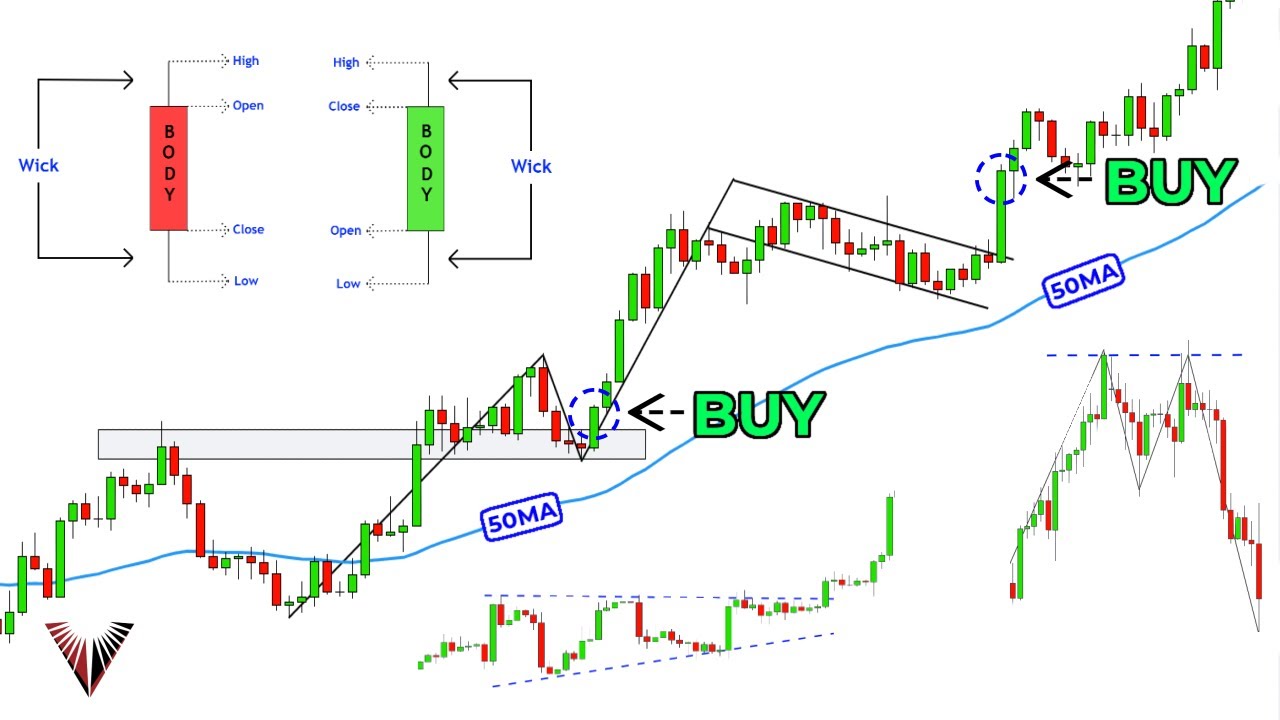
🕯️ Key Candlestick Patterns

Hammer
Bullish Reversal
Small body at top, long lower wick. Sellers tried to push lower but buyers rejected the move. Bullish when it forms after a downtrend at support.
Doji
Indecision
Open and close nearly identical. Neither buyers nor sellers won. Context matters — doji at resistance after an uptrend signals potential reversal.
Engulfing
Reversal Signal
A candle that completely "engulfs" the previous candle's body. Bullish engulfing after downtrend = strong reversal signal. Best with high volume confirmation.
Morning / Evening Star
3-Candle Reversal
3-candle reversal pattern. Morning star (bullish) = big down candle, small body, big up candle. Evening star is the bearish inverse. High reliability at key levels.
Shooting Star
Bearish Reversal
Small body at bottom, long upper wick. Buyers pushed price up but sellers rejected the move. Bearish when it forms after an uptrend at resistance.
Inside Bar
Consolidation / Breakout
A candle whose range falls completely within the previous candle's range. Signals consolidation before a breakout. Direction of breakout determines the trade.
Pin Bar (Wick Rejection)
Key Level Rejection
Long wick with a small body at the opposite end. Shows strong rejection of a price level. One of the cleanest entries when it forms at major support or resistance.
Three White Soldiers
Strong Bullish Trend
Three consecutive bullish candles with small wicks, each closing progressively higher. Strong uptrend confirmation, especially after a period of consolidation or downtrend.

🎯 The Setup Framework — Before Every Trade

1️⃣
Macro Context
Is the macro environment favorable for this type of trade? Are we in a bull or bear market? What's the broader sector doing?
2️⃣
Daily Chart First
Start with the daily timeframe. Identify the major trend, key support/resistance levels, and where price is relative to the 20/50/200 MA.
3️⃣
Zoom In for Entry
Drop to the 1H or 15M chart to find the precise entry. Wait for your pattern confirmation — candlestick signal + volume. Never chase.
4️⃣
Define Risk First
Before entering, define your stop-loss and calculate position size. You must know your max dollar loss before the trade. No entry without a stop.
🏛️ Macro Matters

Understanding the Economy

Every trade happens inside a macro environment. Learn to read economic indicators and align your strategy with the bigger picture.

🏦 Federal Reserve Rate Cycle — How It Affects Markets

📉
Rate Cuts Begin
Fed cuts to stimulate growth. Stocks often rally, bonds rise, USD weakens. Growth and tech stocks lead.
🚀
Expansion
Economy grows, employment rises, consumer spending up. Cyclical sectors (industrials, consumer disc.) outperform.
🌡️
Inflation Rises
Demand drives prices up. Commodities, energy, and real assets become attractive inflation hedges.
📈
Rate Hikes Begin
Fed raises rates to cool inflation. Borrowing costs rise, growth stocks get hit hardest. Value and financials often outperform.
🧊
Slowdown
High rates slow the economy. Defensive sectors (utilities, healthcare, staples) tend to hold up better as growth stalls.

Track live Fed rate probabilities: CME FedWatch Tool ↗  |  Source: federalreserve.gov ↗

📊 Key Economic Indicators Every Trader Tracks

💹
CPI — Consumer Price Index
Measures the change in prices paid by consumers for goods and services. The Fed's primary inflation gauge. Hot CPI = risk of more rate hikes = headwind for stocks.
🔴 High Market Impact
Released monthly by BLS · bls.gov ↗
👷
NFP — Non-Farm Payrolls
Monthly jobs report showing how many jobs were added or lost outside agriculture. Strong NFP = healthy economy. Too strong = inflation concerns = potential rate hikes.
🔴 High Market Impact
Released 1st Friday monthly by BLS · bls.gov ↗
📦
PPI — Producer Price Index
Measures inflation at the producer level. PPI often leads CPI — rising producer prices eventually get passed to consumers. Leading inflation indicator.
🟡 Medium Market Impact
Released monthly by BLS · bls.gov ↗
🏗️
GDP — Gross Domestic Product
Total economic output of the U.S. economy. Two consecutive quarters of negative GDP = recession. Strong GDP supports corporate earnings and stock prices.
🟡 Medium Market Impact
Released quarterly by BEA · bea.gov ↗
🏠
Housing Data
Existing home sales, housing starts, building permits, and Case-Shiller index. Housing is both a leading economic indicator and a consumer confidence gauge.
🟢 Lower Market Impact
Released monthly by Census Bureau / NAR
🛍️
Retail Sales
Monthly measure of consumer spending on goods. Consumer spending drives ~70% of U.S. GDP. Strong retail sales = economic momentum. Weak = caution.
🟡 Medium Market Impact
Released monthly by Census Bureau · census.gov ↗

🔄 Sector Rotation — Which Sectors Lead in Each Cycle

Early Expansion
Technology, Financials
Rate cuts fuel growth stocks. Banks benefit from increased lending activity.
Full Expansion
Industrials, Consumer Disc.
Strong consumer confidence drives spending and manufacturing activity.
Late Cycle / Inflation
Energy, Materials, Real Estate
Hard assets hedge inflation. Energy demand peaks as economy runs hot.
Contraction / Recession
Utilities, Healthcare, Staples
Defensive sectors — people still pay bills, buy medicine, and buy food regardless.
🎓 Learn From the Pros

Run Phase Academy

The creators and resources that will sharpen your edge — technical analysis masters, macro thinkers, and traders who've done it consistently.

🎓 Featured Lesson

Watch & Learn: Educational Breakdown

A clear, beginner-friendly walkthrough — the kind of content that actually makes things click.
Watch educational breakdown on YouTube
Watch on YouTube
📈
Adam Khoo
Technical Analysis & Swing Trading
Systematic approach to technical trading — clear entries, stops, and targets. Teaches how to think probabilistically rather than emotionally about setups.
🌍
Real Vision Finance
Macro Economics & Global Markets
Institutional-grade macro analysis. Learn how global capital flows, central bank policy, and geopolitics shape market cycles. Essential for macro-aware trading.
📚
New Trader University
Systems & Trading Rules
Steve Burns distills decades of trading into clear principles. Risk management, trading systems, and the behavioral finance behind why traders fail and how to fix it.
🔍
Macro Analysts & Hedge Fund Letters
Deep Macro Research
Read hedge fund manager letters, Ray Dalio's Principles, Howard Marks' memos, and Seth Klarman's Margin of Safety. Primary sources — not YouTube summaries.
🏛️
FRED (St. Louis Fed)
Economic Data & Charts
Federal Reserve Bank of St. Louis data platform. Free access to 800,000+ economic data series. The definitive source for GDP, inflation, employment, and yield curve data.
🎯
InTheMoney
Options Strategy
Clear, honest options education for intermediate traders. Covers options mechanics, the Greeks, and defined-risk strategies. When you're ready to explore options — start here.
🕯️
Rayner Teo
Candlestick Charts
Each candle tells a story — who won, buyers or sellers? Rayner breaks down candlestick patterns into clear, actionable setups for any market.
🎯
The Chart Guys
Support & Resistance
Support is a price floor where buyers step in. Resistance is a ceiling where sellers push back. These levels repeat — learn to spot and respect them.
📊
Technical Analysis
Chart Reading Fundamentals
Reading charts is a skill. Learn how to spot patterns, use indicators, and make sense of price action before risking real money.
⚖️
SMB Capital
Risk / Reward
Never risk $2 to make $1. Aim for at least 2:1. This one rule will protect your account more than any indicator ever will.
📈
Trendlines
Trend Direction & Breaks
Connect the swing lows for an uptrend. Connect the swing highs for a downtrend. The trend is your friend — until it breaks.

🛡️ Non-Negotiable Risk Management Rules

1
Never risk more than 1–2% of your account on a single trade. A 10-trade losing streak (which happens to every trader) at 2% = 18% drawdown. Survivable. At 10% per trade = catastrophic.
2
Always define your stop-loss before you enter. If you don't know where you're wrong before you enter, you're gambling — not trading. No exceptions.
3
Minimum 1:2 risk-to-reward ratio. Every trade should risk $1 to make at least $2. You can be right only 40% of the time and still be profitable with a 1:2 R:R.
4
No revenge trading. After a loss, walk away. Never add to a losing trade to "get even." The market owes you nothing. Each trade is independent.
5
Trading capital is separate from your life money. You completed the Crawl phase. Your emergency fund, retirement accounts, and budget are untouchable. Trading capital = money you can lose without consequence to your life.
⚠️ Important Disclaimer: Everything on this page is educational content only — not financial advice. Trading involves significant risk of loss. Past performance, backtests, and paper trading results do not guarantee future live trading results. Always do your own research, consult a licensed financial advisor for personalized guidance, and never trade with money you cannot afford to lose.

Ready to Trade With Mentorship?

You've done the work — budget mastered, market prepared, technically trained. The waitlist is where the 1-on-1 mentorship begins.